Tromppottery
Bohemian Flower Vase with Nerikomi and Mishima Techniques
Bohemian Flower Vase with Nerikomi and Mishima Techniques
Couldn't load pickup availability
Bohemian Flower Vase with Quilt Design Borders
Measures: 3-3/4" wide x 5-5/8" high
Hole for flowers measures: 2-3/8" wide
Bohemian fashion style - Bohemian, or boho, fashion is a relaxed, free-spirited style that incorporates natural fabrics, retro patterns, and flowing silhouettes.
It's often associated with a romantic, nomadic lifestyle.
Tribal prints, paisleys, and florals are all common motifs in bohemian fashion.
Mix and match different patterns as I have done with colored porcelain and underglaze.
Bohemian fashion originated as a counterculture movement in France following the French Revolution, where artists and writers, often living in poverty, adopted a nomadic lifestyle and began wearing clothes that reflected their unconventional way of life, drawing inspiration from the Romani people (often called “Gypsies”).
Bohemian fashion is associated with the hippy era - HELLO!
Beginning our Bohemian flower vase journey at the upper portion of the vase:
Every necklace, bead and nerikomi flower inlay attached while vase was still in its greenware (raw) state. That is everything from the rim down to just above the glazed tulips.
The vase was wheel-thrown with pure white porcelain clay; no color added to the clay body.
A band of flowers was carved into the leather hard clay (not too wet, and not too dry), then filled in with chartreuse color porcelain slip (wet clay). The surface was sanded smooth. The flowers are very subtle and blend in to the background. They are about 1/2" above the glazed tulips.
(Please scroll down to "How It's Made" for techniques - mishima).
Two nerikomi flowers were constructed using color porcelain stripes, checks and square dots, and inlaid into the letter hard clay-
After forming the nerikomi flower, I carved out a section of the vase, in the same shape as the flower, removing excess clay so the flower would sit flush to the vase. Buttons were formed and attached to the flower center.
The second, smaller flower was created in a similar manner, minus the button.
(Please scroll down to "How It's Made" for techniques-nerikomi)
After the inlay techniques were complete, the necklaces were formed using tiny little balls of clay formed with my small handmade mold, or between my fingers for the more oval shaped beads.
YES! Each bead is an individual bead.
This is WHY my son and I take SO LONG TO LOAD THE KILN!
Various agate techniques were used to assemble the remaining necklaces.
(Please scroll down to "How It's Made" for techniques - agateware)
BOTTOM PORTION of the VASE:
The tulips and tiny checks were created using very narrow detailing tape, and glazed with underglazes of various bright colors to coordinate with the necklaces.
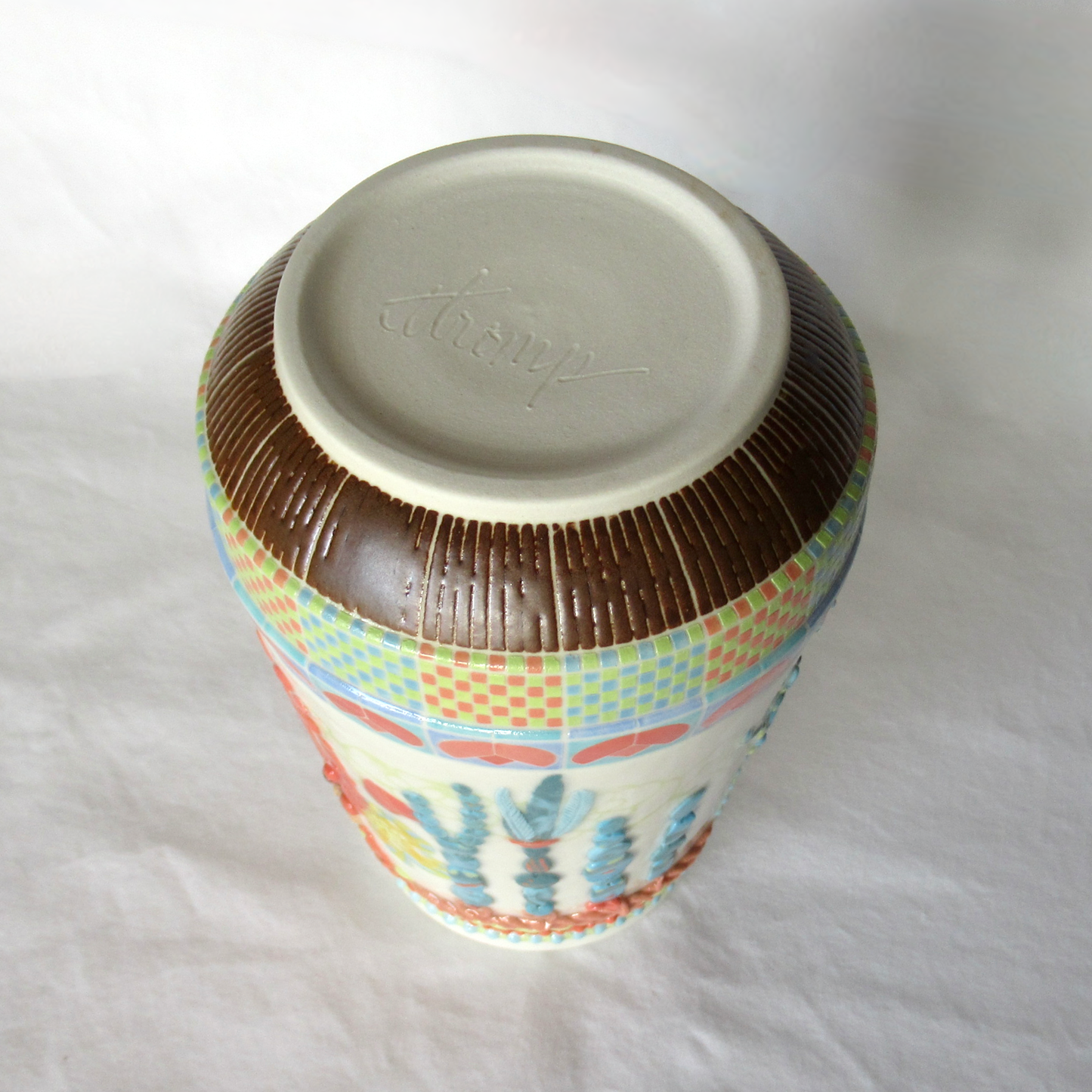
The very bottom band, right above the footring was taped and glazed with a dark brown, satin glaze - Black Walnut.
The entire vase was bisque fired to Cone 04 (1945 degrees Fahrenheit),
then covered with three thin coats of food safe, lead-free clear glaze, and fired to Cone 6 (2232 degrees Fahrenheit).
VASE INSIDE:
The inside of this Bohemian Vase is a very fluid, glossy honey white glaze.
The swirl at the bottom inside is clearly visible through the white glaze.
RIM:
Glossy white.
Wheel-thrown Standard 365 Porcelain Clay.
Glazed with lead-free, dinnerware safe glazes.
Fired to Cone 6 (2232º Fahrenheit).
I recommend washing these hand crafted pieces by hand.
My signature is engraved on the bottom of the bowl.
How It's Made
Some Colored Porcelain Clay Techniques used on this flower vase:
Mishima begins as a design etched into leather hard clay.
Colored slip is placed into the groove created by the etching.
When the surface has dried sufficiently, the excess clay is scraped off, leaving the surface smooth. It is important to use a porcelain slip that is a different color than the surface of the pottery, so the etched design will stand out.
Mishima is level to the surface of the pottery.
Nerikomi - In Japanese, neri is a root word meaning "to mix". Komi means "to press into," as in pressing clay slabs into a mold.
Nerikomi is a hand building technique piecing together various colored porcelain clays that have been stacked, sliced and pressed into a mold to create patterns that run through the entire vessel. I have taken my nerikomi flower design and cut out a section of the vase, matching the shape of the nerikomi flower, and pressed the flower into the surface of the vase, so it is flush to the vase surface.
Agateware is a decorative colored porcelain clay technique combining two or more colors of clay and twisting them to give a marbled appearance similar to agate stones.
All of our handmade pottery is either wheel-thrown or handbuilt in our North Carolina home studio.
Share